

Robert G. Eccles
author FollowSustainability
Tenured Harvard Business School professor, now at Oxford University.
In my previous piece I identified four facts I believe must be addressed for any energy policy and its associated narrative to be politically viable for the vast majority of the American public: (1) climate change is a relatively low priority for most Americans, (2) America is a center-right country, (3) it is becoming more polarized, and (4) the appetite to personally pay to address climate change is quite low. Here I will dig into this deeper, again based on data from an excellent paper “The Science vs. the Narrative vs. the Voters: Clarifying the Public Debate Around Energy and Climate” by Roger Pielke, Jr. and Ruy Teixeira of the American Enterprise institute(AEI), supplemented by more detailed data kindly provided by Dr. Teixeira. The paper is based on a survey of over 3,000 voters that was conducted for AEI by YouGov between September 20-26, 2024.
Using data from this survey and a variety of other sources I propose four basic elements for a U.S. energy policy:
- An “all-of-the above” approach to energy sources.
- Energy choices should be based on economics, not ideology.
- Cost and availability should determine the energy mix.
- Getting the U.S. to net-zero as quickly as possible is a low priority.
I will provide data to support of each element, starting with the first one.
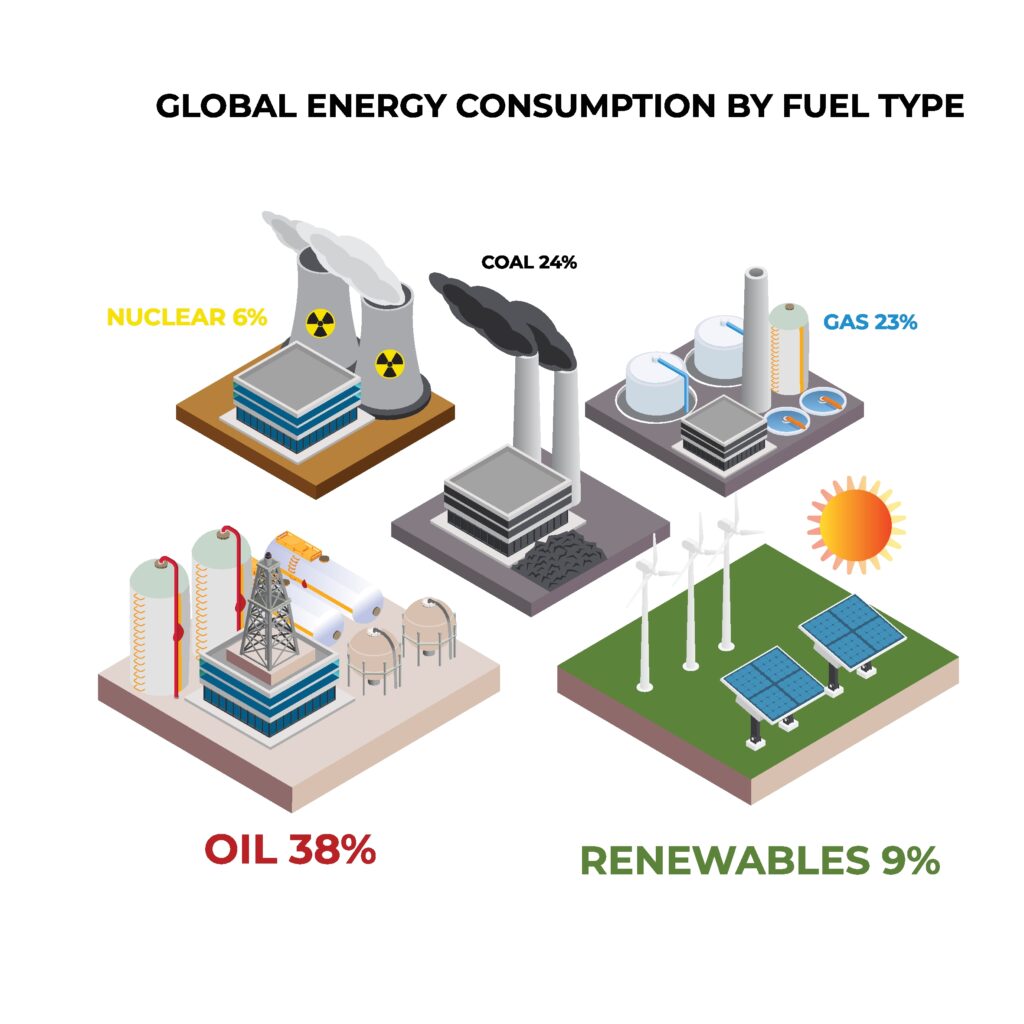
How much energy we consume isometric 3d flat vector illustration concept for banner, website, landing page, ads, flyer template, etc (Photo: iStock)
An “All-of-the-Above” Approach to Energy Sources
Respondents were given three choices for the supply element of an energy policy:
- We need a rapid green industry transition to end the use of fossil fuels and replace them with fully renewable energy sources, regardless of the costs (22%).
- We need an “all-of-the-above” strategy that provides abundant and cheap energy from multiple sources, including oil and gas, renewables, and advanced nuclear power (55%).
- We need to stop the push to replace domestic oil and gas production with unproven green energy projects that raise costs and undercut jobs (23%).
The anti-fossil fuel and anti-renewables crowds are less than the “all-of-the-above-crowd.” An energy policy that ignores this will get traction depending on which party is in office but not beyond that. This is highly problematic since climate change is a forever issue and we need stable and long-term policies to deal with it, policies which can only be created in a bipartisan way.
SUBSCRIBE TO OUR NEWSLETTER
Subscribe our newsletter to receive the latest news, articles and exclusive podcasts every week