
Robert G. Eccles
author FollowSustainability
Tenured Harvard Business School professor, now at Oxford University.
The issue of climate narratives is something very much on my mind these days. Two years ago I wrote about five climate change narratives (Scientific, Skeptical, Doomsday, Opportunistic, and Moral) and three months ago I wrote that we need a new American narrative for climate change. Thus it was with great interest that I read the recent paper “The Science vs. the Narrative vs. the Voters: Clarifying the Public Debate Around Energy and Climate” by Roger Pielke, Jr. and Ruy Teixeira of the American Enterprise institute (AEI). The paper is based on a survey of over 3,000 voters that was conducted for AEI by YouGov between September 20-26, 2024. The findings are fascinating and telling. They are also important to take into account when constructing a narrative about climate change in America that will lead to stable, long-term bipartisan policies. Political oscillations are as much of a challenge to dealing with climate change as climate change itself.
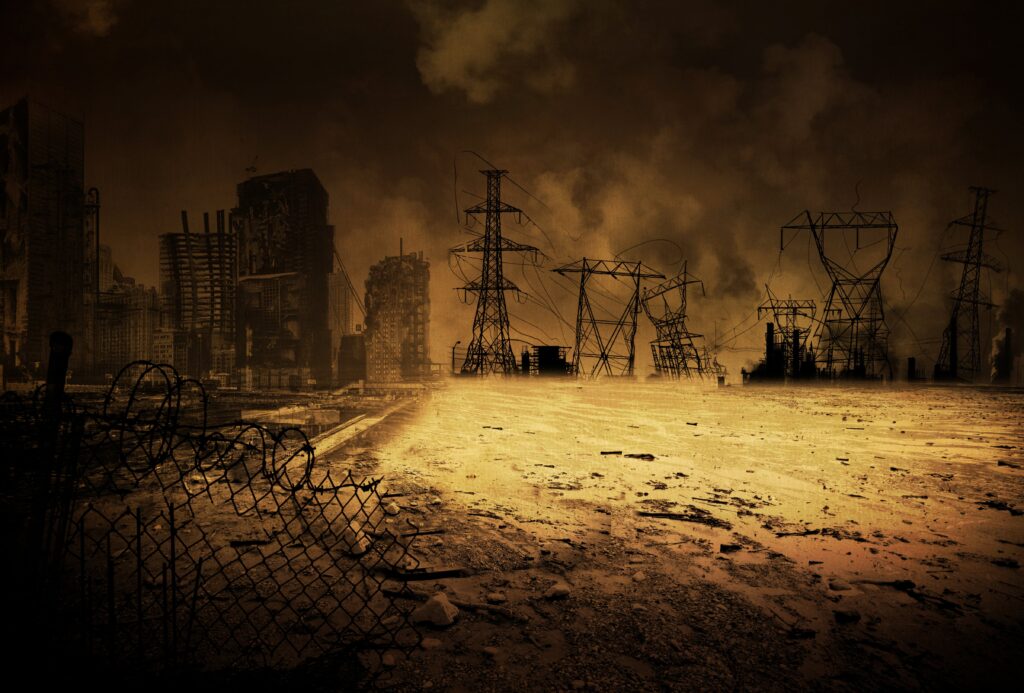
Background image with an apocalyptic scenario (Photo: iStock)
The fundamental thesis of the paper is that “Both the public’s views and the Intergovernmental Panel on Climate Change’s (IPCC) scientific analysis differ in important respects from a narrative that has come to dominate the mainstream media discourse and public understandings of climate and energy.” In short, the media has largely adopted a Doomsday scenario which is at odds with the position of the IPCC. At the same time, and somewhat ironically, the result is a public perception that the IPCC’s views are more catastrophic than they really are. The AEI report notes that “the IPCC does not associate climate change with existential, apocalyptic, or catastrophic outcomes.” Yet 77% of respondents answered “Yes” to the question “Does the IPCC think there is a tipping point beyond which temperature rise from the current day will produce catastrophic results for human civilization?”
Especially telling is how stable this number is. My fellow Ph.D. sociologist Ruy Teixeira kindly provided me the detailed crosstabs for the survey. The range around 77% was tight and insignificant across age groups, gender, race, marital status, having children under 18 or not, full time vs. non-full time employment, union household or not, and income. Not surprisingly, the biggest ranges were along the political dimension. The highest percentage was for registered Democrats (86%), liberals (91%), and Biden voters (87%). Independents and moderates were at 77%. Republicans, conservatives, and Trump voters were all at 66%. This shows how pervasive the Doomsday scenario has become even as people are leaving mainstream media for their own social media echo chambers which tend to both have more misinformation and higher levels of engagement. But you have to love the irony of the 66% groups being a bit less uninformed about what the IPCC has to say than the others.
SUBSCRIBE TO OUR NEWSLETTER
Subscribe our newsletter to receive the latest news, articles and exclusive podcasts every week