Tropical rainforests represent one of our planet’s most critical natural assets in the fight against climate change, storing approximately 25% of all terrestrial carbon despite covering just 6% of Earth’s land surface. Of the world’s roughly 1.84 billion hectares of tropical forests—an area roughly the size of Russia—Brazil contains some 420 million hectares (an area about two-thirds the size of Australia), including 60% of the Amazon rainforest. The Amazon alone stores an estimated 140–200 billion tons of carbon, an amount equivalent to about 15–20 years of current global fossil fuel CO₂ emissions. Forests are also important to the water cycle since they store moisture, known as “green water.” A recent World Bank Group
report found that deforestation-driven reductions in green water can lead to annual losses of around $379 billion, or about 8 percent of global agricultural GDP.
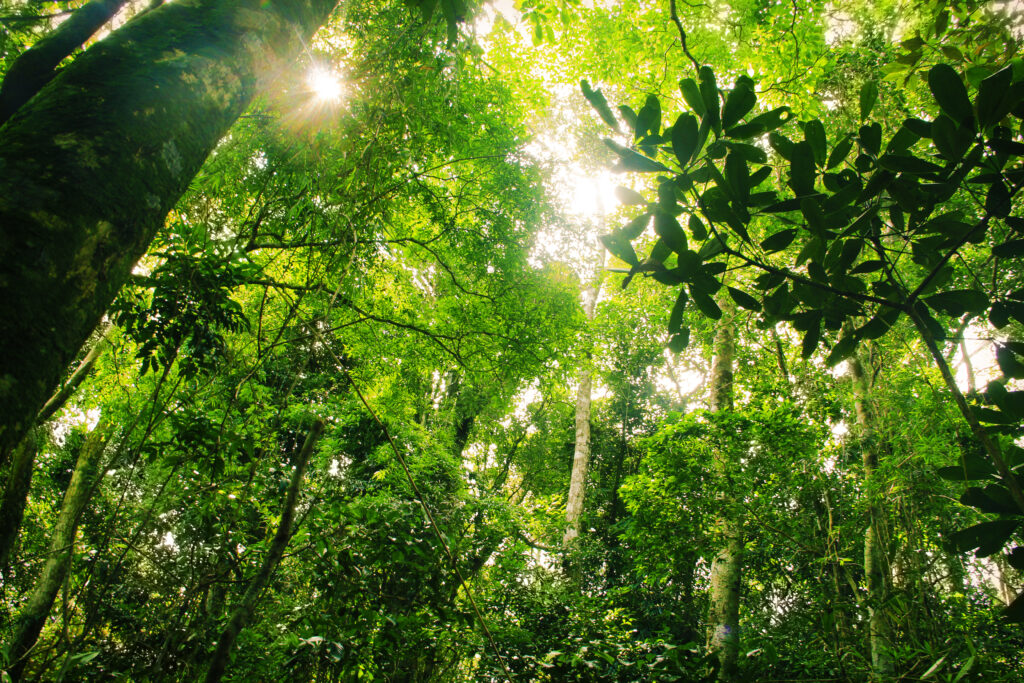
Brazilian rainforest in national park Tijuca, Rio de Janeiro (Photo: iStock)
Yet we are losing this natural infrastructure at an alarming rate. Tropical deforestation currently removes about 3–4 million hectares of forest each year, with total global forest loss reaching up to 10 million hectares. In 2024 alone, Brazil’s Amazon lost approximately 954,000 hectares of primary forest—more than twice the size of Rhode Island—despite recent improvements. Scientists warn that the Amazon may reach an irreversible tipping point if deforestation exceeds 20–25% of its original forest cover. Today, that figure already stands at 17–20%, risking a shift from a vital carbon sink to a net carbon source, while also destabilizing regional weather systems that sustain agriculture across South America. When intact, tropical forests absorb roughly 2 billion tons of carbon annually—about 5% of global fossil fuel emissions—making their protection one of the most cost-effective climate solutions available
The Business Drivers of Deforestation
Businesses, especially in agriculture, are central to deforestation patterns that threaten environmental stability and future economic prosperity. For example cattle ranching is responsible for roughly 80% of deforested land in the Amazon, while soy cultivation has driven large-scale conversion of the Cerrado savanna. Brazil’s agribusiness sector, valued at about $500 billion annually and accounting for over 20% of national GDP, generates approximately 40–50% of the country’s exports. The sector is vast, including over 2 million cattle operations and 240,000 -300,000 soybean farms, many of which engage in both activities. Most are small, family-run businesses—about 70% of farms are between 1 and 50 hectares—but the largest 1% of properties (over 1,000 hectares) control nearly half of Brazil’s agricultural land.
The problem isn’t that agribusiness is inherently anti-environmental, but that current market systems fail to recognize the full value of standing forests. For instance, a hectare cleared for cattle pasture typically generates just $100–$200 in annual income, while the same area of intact Amazon forest provides ecosystem services worth several times more. Estimates range from $400 to over $700 per hectare per year, depending on the region and valuation method, though some recent research puts the value even higher. But the former is hard cash, and the latter is still largely considered an intangible.